
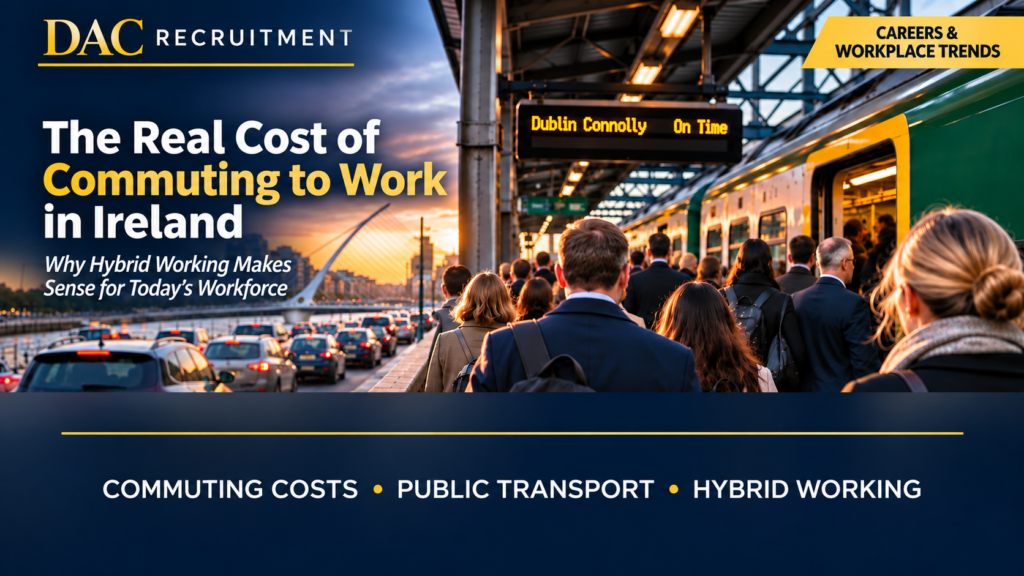
There is a cost to going to the office that never appears on a payslip. Petrol or diesel. Bus and rail fares. Parking. And the time spent getting to work and back. For many Irish employees, that cost now matters almost as much as the salary on offer.
Hybrid working is not simply an attractive benefit. For legal professionals commuting to Dublin and other Irish cities, it can make a measurable difference to household budgets, time and quality of life.
What does driving to work cost?
According to AA Ireland’s October 2026 survey, the average pump price was €1.98 per litre of petrol and €2.15 for diesel (rounded). These costs add up surprisingly quickly.
Consider an illustrative employee driving a 60 km round trip in a petrol car using 6.5 litres per 100 km, across 46 working weeks each year. These are example assumptions, not national commuting averages.
Commuting five days a week would cost approximately €1,778 in petrol annually. Three days a week would cost around €1,067, a saving of roughly €711.
If parking costs €12 per office day, avoiding two office days a week saves a further €1,104. Together, the illustrative saving reaches €1,815 a year, before tolls, wear and tear or depreciation. Of course, someone with free parking or a shorter commute would save less.
Public transport: cheaper, but not always comfortable
The Transport for Ireland 90-minute fare is €2 for an eligible adult journey within Dublin Zone 1. If an employee pays €2 each way for 46 weeks, five days of commuting costs €920 annually, compared with €552 for three days. That is a potential €368 difference.
Actual fares vary. Weekly caps, TaxSaver tickets and season passes can reduce costs; longer journeys from outside central Dublin may cost substantially more. The same choice looks different for someone commuting from Kildare, Meath, Wicklow or beyond.
Price is not the only issue. Crowded trains, standing for extended periods, delays and inconsistent connections can make the commute exhausting, especially when a passenger then has a full working day ahead.
Irish Rail has acknowledged peak-time pressure
In a June 2026 statement to an Oireachtas committee, Iarnród Éireann reported more than 55 million passenger journeys in 2025 and acknowledged capacity pressure on a number of key routes at the busiest times. The National Transport Authority’s 2025 Rail Census illustrates the scale of passenger demand.
This does not mean every train is overcrowded. But for employees regularly facing packed services or lengthy standing journeys, commuting can be physically uncomfortable and stressful. Employers should not ignore that reality when deciding how much office attendance is necessary.
What about the hours we lose?
A 90-minute daily round-trip commute adds up to seven and a half hours a week over five office days. Moving from five days to three removes 138 hours of travel over 46 working weeks, the equivalent of almost six full 24-hour days.
For some employees, the time saved is more valuable than the money: collecting children, exercising, spending time with family or simply having a less exhausting working week.
Why this matters for law firms
Office time still has real value. Junior solicitors benefit from mentoring, supervision and seeing experienced colleagues at work. Team discussions, client meetings and professional relationships are often easier in person.
But there is a difference between attending for a clear purpose and commuting merely to sit at a desk doing work that could be carried out effectively elsewhere.
For firms seeking to recruit or retain talented solicitors, a realistic hybrid policy can be a genuine advantage. Candidates increasingly consider the total cost of accepting a role, not simply the headline salary.
A more sensible approach
The better question may not be how many days everyone must attend the office, but which activities genuinely benefit from being together. A clear policy that balances training, client service, collaboration and flexibility is more persuasive than an arbitrary attendance requirement.
At DAC Recruitment, we work with solicitors and law firms on career opportunities across Ireland. If working arrangements, commuting or progression are influencing your next move, explore our current legal vacancies or contact us for a confidential conversation.
Sources and assumptions
Sources: AA Ireland fuel-price survey, October 2026; Transport for Ireland fares; Iarnród Éireann Oireachtas statement, June 2026; NTA Rail Census 2025. Fuel calculations assume 60 km per office day, 6.5 L/100 km, 46 working weeks and the October 2026 AA price. Parking is a hypothetical €12 a day. Actual costs vary.